- Home
- Damp services
- Woodworm and rot treatment
Woodworm and rot treatment in Stafford
Woodworm and rot treatment in Stafford for homes with holes in joists, soft skirtings or fungus behind plaster. Stafford Damp Proofing identifies the insect or fungus, checks whether it is still active, finds the moisture feeding it, and limits chemical treatment to the timber that needs it.
Get timber checked
Tell us where the property is and what you can see. We call back to talk it through.
- Live or historic woodworm confirmed
- Rot identified before quoting
- Moisture fixed before chemicals
How do you tell dry rot from wet rot?
By what the fungus does beyond the wood: dry rot can spread across masonry to reach other timber, while wet rots usually stay where the timber is regularly wet. That is the distinction the Property Care Association draws, and it adds that wet rots can be as destructive as dry rot and that the wet and dry labels are very misleading. Wet rot is a loose name for wood-destroying fungi other than dry rot, including cellar fungus and mine fungus.
Dry rot is the fungus Serpula lacrymans (BRE). Its signs, according to the PCA's article on fungal biology, include cords a few millimetres wide that start white and turn yellow and brown, and sponge-like fruiting bodies in ceiling cornices or wall corners that release rusty red spores, sometimes up to 10 metres from the wood feeding them. RICS isurv calls cuboidal cracking on skirting boards the classic sign, and notes that by the time fruiting bodies appear the outbreak is well established.
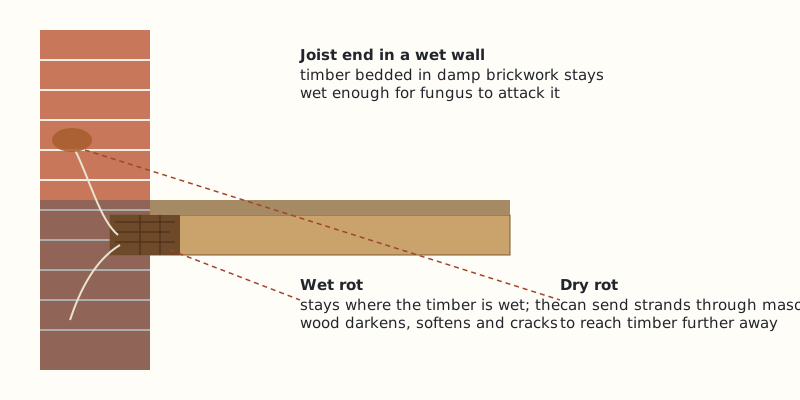
Our dry rot vs wet rot guide goes further into identification.
Does dry rot make its own water?
Not in any way that sets it apart. BRE researchers say its ability to carry water to drier areas is limited, and that while decay does produce some water, dry rot is no different in that from other wood-rotting fungi. Like other wood-rotting fungi it needs wood and water, and decay stops when timber moisture falls below about 20%. The PCA likewise says the fungus can only colonise wood above about 20% moisture content, grows best near 20°C, weakly at 26 to 27°C and not at all above 28°C.
Its strands can grow through and across masonry, but BRE points out that they get no nourishment from it, so a wall is a route, not a food source. The practical lesson is that drying the building is the cure, rather than chasing strands through brickwork.
How is dry rot treated without soaking the house in chemicals?
By taking the water away first and using fungicide only where it is needed. BRE's guidance on historic buildings says primary control of dry rot must be environmental, fixing moisture sources and promoting drying, and questions blanket fungicide irrigation of masonry because it adds water and risks salt damage; localised treatment is preferred. The PCA's wood rot guidance sets out the same order: find and stop the water, have a specialist identify the organism and how far it has gone, then repair, replace or reinforce timber, with chemicals used only for short-term protection.
MyBuilder gives £500 to £1,500 for a small localised dry rot job and £1,500 to £5,000 per room for structural repair, on an undated page; those are national guide prices, not ours.
Which woodworm beetles damage timber in British homes?
Three matter most, and their exit holes help tell them apart. The PCA's guide to wood-destroying insects describes:
- Common furniture beetle: round exit holes about 1.5 mm across, fine gritty bore dust, larvae that take 3 to 5 years, and most damage in timber that has been in use for 10 years or more.
- Deathwatch beetle: round holes about 3 mm across, bun-shaped pellets in the frass, and a preference for decayed hardwoods.
- House longhorn beetle: attacks the sapwood of softwoods such as roof timbers, with little outward sign; the PCA says it is restricted to certain localities, such as Surrey and West London.
Building Regulations require specific protection against house longhorn beetle for building work in the Surrey area, according to LABC. No source we have places Stafford in that area.
How can you tell if woodworm is still active?
Look for fresh signs, and if in doubt, wait and look again. The PCA says timber should be checked for current activity before any treatment, because historic signs alone may not justify it. Peter Cox describes fresh frass beside clean emergence holes as the mark of an active infestation. RICS suggests laying tissue paper over the timber and checking for new holes on a return visit, and says wood-borers are most active from April to August; Which? gives a longer window of March to October.
The RICS article also says treatment is pointless if the dampness behind the attack is not controlled. So a woodworm visit from Stafford Damp Proofing includes the moisture checks from a damp survey. As a national yardstick, Checkatrade gives £500 to £1,000 for professional treatment and £400 to £900 for treating a 3-bed house loft (September 2024), which is not our price.
What does the Ancient High House say about timber in Stafford?
That timber framing runs deep in the town's history. Stafford Borough Council says the Ancient High House was built in around 1595 and is reputed to be the largest surviving timber-framed town house in England from the Tudor period. Historic England lists it at Grade II* and records a restoration from 1976 to 1986.
Much of the town's timber is less visible. The conservation area appraisal says the first brick building was the Swan Hotel in the mid-17th century, and that many early timber-framed buildings were faced with brick in the 19th century, so frames and joists can sit inside walls that look like solid brick from the street. Where timber meets damp masonry, decay follows the moisture, which is why our timber inspections start at the wall.
Who should identify rot or woodworm?
Someone trained to identify timber decay, who will tell you what it is before quoting. The Property Care Association's CSTDB qualification, formerly CSRT includes a timber module in which candidates identify the fungus or insect in twelve timber samples; the damp-only CSDB does not include that module. Ask any firm which of these its surveyor holds, whether the infestation is active, and what will stop the timber getting wet again. For damp in walls, floors and rooms, see our page on damp proofing in Stafford.
Questions we get asked
Do old woodworm holes mean I need treatment?
Not necessarily. Old holes with no fresh dust may mark an attack that ended long ago, so we check for activity before recommending anything.
Is wet rot less serious than dry rot?
Not in itself. Wet rot can do as much damage to the timber it is in; the difference is that dry rot can spread across masonry to other wood.
Will the whole house need spraying?
Treatment should be limited to timber that is affected and still at risk, once the moisture behind it is dealt with. We do not recommend blanket spraying as a precaution.
Can rot come back after a repair?
Yes, if the timber gets wet again. Keeping it dry is what stops decay, so the repair includes fixing the leak or penetrating damp that started it.
Where these facts come from
- Property Care Association: Wood rot (guidance, ©2024)
- Building Conservation Directory: dry rot and its treatment in historic buildings, by BRE's Carey and Grant (1999)
- Property Care Association: Dealing with dry rot: insights from fungal biology
- RICS isurv: Building defects database: dry rot (2017, modified 2019)
- MyBuilder: dry rot treatment cost (undated)
- Property Care Association: Wood Destroying Insects in Buildings (May 2016)
- LABC: Are you house longhorn beetle's fan? (Jan 2018)
- Peter Cox: the woodworm species found in UK buildings
- RICS Property Journal: On the lookout for wood-boring insects (3 May 2020)
- Which?: How to treat woodworm (11 Mar 2026)
- Checkatrade: woodworm treatment cost (updated 9 September 2024)
- Stafford Borough Council: the Ancient High House
- Historic England: High House, Greengate Street, list entry 1212192
- Stafford Borough Council: Stafford conservation area character appraisal (2011)
- Property Care Association: the CSTDB and CSDB damp and timber qualifications
Useful to have ready
Answers to these let us tell you on the phone what kind of damp it probably is.
- The postcode and roughly when the house was built
- Where the damp shows and how high up the wall
- Whether it gets worse after rain, or in cold weather
- Any mould, and in which rooms
- Whether you own, rent or are buying, and any survey deadline
Woodworm and rot treatment beyond Stafford
Need woodworm treatment somewhere other than the county town? The page below covers that town's own housing and the damp it tends to bring, and our damp proofing in Stafford page has the full picture.
Read these first
Dry rot or wet rot: what is the difference?
The difference between dry rot and wet rot is how far it spreads, not how much harm it does. Signs, causes and treatment order.
What do damp surveys and damp proofing cost?
National price yardsticks for damp surveys, injection, ventilation, woodworm, dry rot and tanking, each credited and dated, with what pushes a job up or down.
Related damp work
Other work we take on
Damp surveys
A survey that works out where the water is coming from, outside and in, before anyone mentions treatment.
Rising damp treatment
Ground moisture proved with samples first, then bridged damp courses cleared or a certified injection fitted where the evidence calls for it.
Penetrating damp repairs
Rain finding its way through walls, chimneys or tired pointing, traced back to the fault outside and repaired before plaster goes back.
Condensation and mould
Black spots and streaming windows traced to humidity, cold surfaces and stale air, then cured with ventilation and heating rather than chemicals.
Rather we phoned you?
Leave a name, a number and the postcode of the property. A line about what the damp is doing helps. Or phone 01785 335365.