- Home
- Damp guides
- Dry or wet rot
Sources opened and read on 12 November 2026
Dry rot or wet rot: what is the difference?
Rotten timber in a Stafford house needs a name before it needs a treatment. This guide explains the real difference between dry rot and wet rot, how to recognise each, why both start with water, and what national price guides say. It is for owners, buyers and landlords facing soft or cracked wood.
Arrange a damp survey
Tell us where the property is and what you can see. We call back to talk it through.
What is the real difference between dry rot and wet rot?
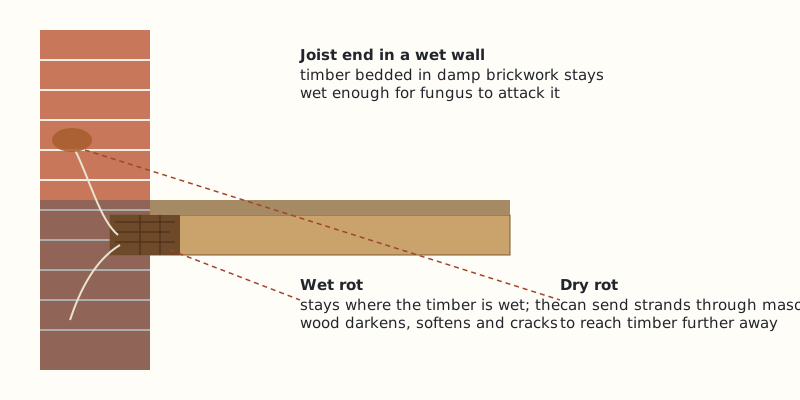
How far it can spread, not how much damage it does. The Property Care Association says dry rot can spread over masonry to reach other wood, while wet rots usually stay where the timber is regularly wet. It adds that wet rots "can be as destructive as dry rot".
The names do not help. Dry rot is decay caused by one fungus, Serpula lacrymans. "Wet rot" is a loose label for the other wood-destroying fungi, with common names such as cellar fungus and mine fungus. The PCA says wet rots "do not have to be any wetter than dry rots" and calls the wet and dry split "very misleading".
The spread matters because of what dry rot can reach. BRE researchers explain that its strands can grow through and across masonry, though the fungus gets no nourishment from the brick or stone. That lets an outbreak link timbers some distance apart, which is why its extent has to be traced before any repair is planned.
How do you recognise dry rot?
By cracked, shrunken wood and, in a well-established outbreak, strands and fruiting bodies. The RICS isurv defects database calls cuboidal cracking on skirting boards the classic sign: the timber splits into rough cubes. It describes pancake-shaped fruiting bodies on ceilings and says their appearance shows the outbreak is already well established.
The PCA's notes on fungal biology add detail. Strands, or cords, are a few millimetres wide, start white and turn yellow and brown, and often remain after an outbreak has died. Fruiting bodies are sponge-like, usually appear in ceiling cornices or wall corners, and release rusty red spores; they can form up to 10 metres from the wood that feeds them, connected by cords. The fine threads can also run behind plaster and flooring through gaps a few microns wide, so what shows on the surface is rarely all of it.
How do you recognise wet rot?
By decay confined to timber that stays wet, usually close to an obvious water source. Typical places are joist ends built into a damp wall, timber under a leaking gutter or roof, and wood near a plumbing leak. Because wet rots usually stay where the wood is regularly wet, mapping the damp tends to map the decay.
Telling one wet rot from another, or from dry rot, is a job for someone trained to do it. BRE's Digest 345 covers the main wet rots and how to tell them from dry rot. When you ask a surveyor to look, ask whether they hold the Property Care Association's CSTDB (formerly CSRT): its timber module includes identifying the fungus or insect in twelve timber samples.
Why does the 20% moisture figure matter?
Because rot stops when the wood dries below it. BRE says decay stops when timber moisture content falls below about 20%, and the PCA says the fungus can colonise wood only above about 20% moisture content.
That makes drying the most powerful treatment there is. It also makes timber one of the few materials where a moisture meter is genuinely useful: RICS says meters are accurate for timber, even though they can mislead on masonry. One caution from the isurv database: at an advanced stage, a low meter reading does not rule out an outbreak, so it is not proof on its own.
Temperature plays a part too. The PCA says dry rot grows best near 20°C, weakly at 26 to 27°C, and not at all above 28°C, which helps explain why it is a problem of cool, damp, unventilated spaces.
Does dry rot make its own water?
Not in any way that sets it apart. BRE researchers write that much mythology surrounds dry rot: its ability to carry water to drier timber is limited, and although decay does produce some water, dry rot is no different in that from other wood-rotting fungi. Like them it needs both wood and water, and it decays timber only where the timber is wet enough.
This matters for what you pay for. If dry rot needs a water source, then finding and stopping that source is the treatment, and chemicals are a supporting measure. A quote built mainly around spraying walls, with no clear account of where the water is coming from, has the order the wrong way round.
How should rot be treated, and in what order?
Water first, then identification, then timber repair, with chemicals last and local. The PCA sets out the sequence: find and stop the water; have a specialist identify the organism and how far it extends; repair, replace or reinforce the affected timber; and use chemical fungicides only for short-term protection, within a strategy centred on removing the water.
BRE says the primary control of dry rot must be environmental: fix the moisture sources and help the building dry. It questions blanket fungicide irrigation of masonry, because it adds water and risks salt damage, and prefers localised treatment.
The water source is often a penetrating damp fault such as a gutter, downpipe or roof leak. Our timber treatment work follows that order, across damp and timber surveys in Stafford and the surrounding towns.
What does rot treatment cost?
National price guides put a small local job in the hundreds and widespread rot in the thousands, but these are not our prices. MyBuilder, on an undated page, gives a dry rot survey at £200 to £500, a small localised job at £500 to £1,500, structural repair at £1,500 to £5,000 per room, widespread rot at £5,000 to £12,000 or more, severe cases at £12,000 to £20,000 or more, and joist replacement at £250 to £350 per joist.
The biggest factor in that range is how long the water has been getting in, which is why early investigation pays. Our damp proofing cost guide sets these figures beside credited yardsticks for surveys, woodworm and other damp work.
Questions we get asked
Is wet rot less serious than dry rot?
Not necessarily. The PCA says wet rots can be as destructive; the difference is that dry rot can travel across masonry to reach other timber.
Can I just spray the wood with fungicide?
Not as a cure. The PCA and BRE both put stopping the water first and treat fungicide as a limited, local measure.
Who should identify the rot?
Someone qualified to identify timber fungi. Ask whether the surveyor holds the Property Care Association's CSTDB, formerly CSRT, which includes a timber identification module.
Does a low moisture reading mean the rot has stopped?
Not on its own. The RICS isurv database warns that a low reading at an advanced stage does not rule out an outbreak.
Where these facts come from
- Property Care Association: Wood rot (guidance, ©2024)
- Building Conservation Directory: dry rot and its treatment in historic buildings, by BRE's Carey and Grant (1999)
- RICS isurv: Building defects database: dry rot (2017, modified 2019)
- Property Care Association: Dealing with dry rot: insights from fungal biology
- BRE: Wet rots, recognition and control (Digest 345, 1989)
- Property Care Association: the CSTDB and CSDB damp and timber qualifications
- RICS: damp and mould, a consumer guide (16 June 2025)
- MyBuilder: dry rot treatment cost (undated)
Useful to have ready
Answers to these let us tell you on the phone what kind of damp it probably is.
- The postcode and roughly when the house was built
- Where the damp shows and how high up the wall
- Whether it gets worse after rain, or in cold weather
- Any mould, and in which rooms
- Whether you own, rent or are buying, and any survey deadline
Ready to have someone look? Our damp proofing in Stafford page sets out what we survey, what we treat and where we go.
Where this guide leads
Woodworm and rot treatment
Woodworm, wet rot and dry rot identified properly, live or long dead, with the damp behind them fixed before any timber is treated.
Penetrating damp repairs
Rain finding its way through walls, chimneys or tired pointing, traced back to the fault outside and repaired before plaster goes back.
More reading
What do damp surveys and damp proofing cost?
National price yardsticks for damp surveys, injection, ventilation, woodworm, dry rot and tanking, each credited and dated, with what pushes a job up or down.
Is it rising damp or condensation?
Where each kind of damp shows, when it gets worse, why meters mislead, and the drilled-sample test that separates rising damp from condensation.
Why is black mould growing on my walls, and how do I stop it?
Why black mould appears on cold walls and in bedrooms, who it harms most, and which fixes last longer than a bottle of mould wash.
Is rising damp a myth?
Rising damp is real but less common than often claimed. Both sides of the debate, the evidence, and the steps everyone agrees on.
What is Awaab's Law, and what does it mean for damp and mould in rented homes?
Who Awaab's Law covers, the deadlines social landlords must meet on damp and mould, and where private renting stands in late 2026.
Can cavity wall insulation cause damp?
When cavity wall insulation lets damp through, which walls should never have been filled, and how to complain if yours was.
Rather we phoned you?
Leave a name, a number and the postcode of the property. A line about what the damp is doing helps. Or phone 01785 335365.