- Home
- Damp guides
- Damp or condensation
Sources opened and read on 12 November 2026
Is it rising damp or condensation?
If a wall in your Stafford home is damp, the cause decides the fix. Rising damp and condensation leave different clues, in different places, at different times of year. This guide shows homeowners, buyers and landlords how to read them, and when only a drilled-sample test will settle the question.
Arrange a damp survey
Tell us where the property is and what you can see. We call back to talk it through.
What is the quickest way to tell rising damp from condensation?
Look at where the damp sits and when it is worst. Rising damp stays low on ground-floor walls and leaves a tide mark with salts; condensation gathers on the coldest surfaces in any room, on any floor, and gets worse once the heating season starts.
UKHSA and DHSC guidance describes condensation as moisture from everyday indoor activity settling on cold surfaces, and calls it the most common form of damp. It describes rising damp as ground moisture rising through walls and floors, usually in older properties and often because of a defective damp-proof course. The national figures follow that order: in the English Housing Survey's surveyor-assessed results for 2024, serious condensation and mould affected 3% of homes in England, and rising damp 1%.
Where does rising damp show on a wall?
At the foot of ground-floor walls, climbing to a fairly level tide mark. The Property Care Association Code of Practice describes water drawn up from the ground by capillary action, typically showing as a tide mark up to about a metre, usually with salts concentrated just above it. A summary of BRE Digest 245 notes that it can go higher where walls stand in water or saturated soil, so "typically up to about a metre, sometimes higher" is the fair description.
SPAB says genuine rising damp shows signs such as a tide mark and likely high nitrate levels, which come from the ground. Those salts attract moisture from the air, so the plaster can stay stained and crumbly even in a dry spell.
The PCA Code also says a damp-proof course is expected in buildings after 1875, and that a surveyor should check whether it has been bridged or buried. A RICS building pathology article describes a case commercially diagnosed as a failed damp course where the real cause was a high patio outside bridging it.
Where does condensation show up?
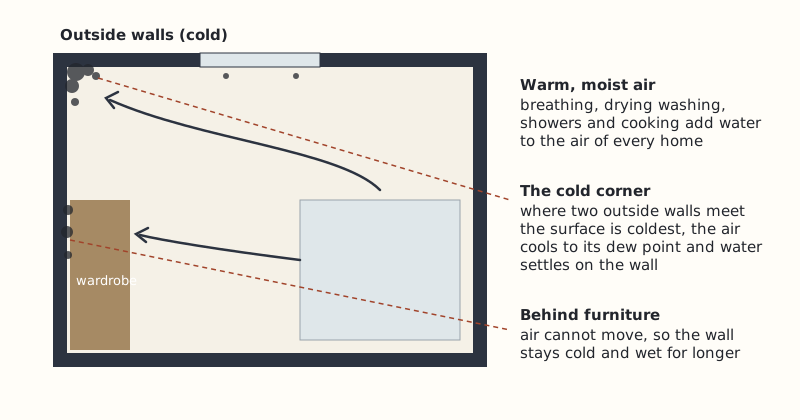
On cold surfaces where moist air sits still. NHBC lists windows, colder parts of walls, the area around door and window openings, the line where ceilings and floors meet outside walls, and poorly ventilated spots such as cupboards and the wall behind furniture. Scottish building standards guidance adds thermal bridges such as lintels, window jambs and sills, and the junction where an inside wall meets an outside one.
That pattern rules the ground out. Condensation turns up in upstairs bedrooms, high in corners near the ceiling and on the wall behind a wardrobe, all places ground water cannot reach. It tends to bring black mould spots, where rising damp more often leaves staining and loose, salty plaster near the floor.
When does each one get worse?
Condensation peaks in cold weather with the heating on; damp from the ground or from rain follows the wet. Timberwise explains that in winter, cold outside air chills walls and windows, so warm, moist indoor air reaches its dew point on them more often. A patch that appears every autumn and fades by summer points that way.
Single readings can mislead in either direction. The PCA Code says one-off measurements only show that conditions allowed condensation at that moment, so longer-term logging may be needed.
Rising damp changes more slowly. The BRE Digest 245 summary links its height to how fast the wall can dry, the salt in wall and soil, groundwater level and heating. A low patch that flares after heavy rain deserves a second look, because SPAB notes that rainsplash can mimic rising damp, and SPAB's technical director warns that ground levels raised too high around a building cause moisture problems. Both are penetrating damp faults with outside fixes.
Why can a damp meter not tell them apart?
Because it reads electrical behaviour on a relative scale and has no way to know where the water came from. The PCA's guidance on moisture meters says resistance and capacitance meters show a pattern of moisture rather than an absolute moisture content, and that salts in a wall can produce high readings on their own. The PCA Code goes further: meters cannot distinguish one moisture source from another, so every possible cause has to be considered.
RICS tells homeowners to "be wary of any surveyor or commercial specialist who uses only a damp meter". SPAB's technical director, writing for Homebuilding & Renovating, says one set of high readings may point to rising damp when the real cause is condensation, which leads to damp courses nobody needed. He recommends continued monitoring instead.
Which test separates rising damp from condensation?
Drilled samples taken from inside the wall. The PCA Code, citing BS 5250, says samples from within the wall will not be damp if surface condensation is the only cause. Wet masonry deep down near floor level, drying out higher up, makes ground moisture a real candidate; a wet surface over dry masonry does not.
The PCA meter guidance sets out the method: samples drilled at depth, above and below the damp-proof course line, sealed in airtight containers with their positions recorded, then tested. Oven-drying, the gravimetric method, is the most accurate and can separate ground moisture from salt-attracted moisture using the BRE Digest 245 technique; the PCA recommends it where there is a dispute. The quicker calcium carbide test takes 3 to 5 minutes a sample on site but cannot make that separation directly.
What should you do if you are still not sure?
Get the cause confirmed before paying for a cure. A damp survey that checks the outside, reads the pattern inside and takes drilled samples where needed gives an answer you can act on. If it is condensation, our condensation and mould page covers ventilation and heating; if ground moisture is confirmed, rising damp treatment sets out the options.
That is how Stafford Damp Proofing works on damp surveys in Stafford, Stone, Cannock and the villages between. For the wider argument about how often rising damp is real, read is rising damp a myth?, and for mould in particular see black mould on walls.
Questions we get asked
Can a house have rising damp and condensation at the same time?
Yes. The two can sit in the same house, which is why each patch should be traced on its own rather than one diagnosis being applied to every room.
Is black mould a sign of rising damp?
Not usually on its own. Mould in cold corners, around windows and behind furniture points to condensation, while rising damp tends to leave a tide mark and salts low on the wall.
Can I rely on a damp meter reading on plaster?
Only as a pattern. The PCA says meters on masonry give comparative readings, and salts can push them high in a wall that is not wet.
Where these facts come from
- GOV.UK: Understanding and addressing the health risks of damp and mould in the home (first published 7 Sep 2023, updated 1 Apr 2026)
- GOV.UK: English Housing Survey 2024 to 2025, housing quality (29 January 2026)
- Property Care Association: Code of Practice for the investigation and control of dampness in buildings (March 2017)
- Designing Buildings Wiki: summary of BRE Digest 245 on rising damp
- SPAB: What is rising damp?
- RICS Built Environment Journal: Understanding dampness: a pathological approach (5 Nov 2026)
- NHBC: Condensation in your home (homeowner leaflet)
- Scottish Government: building standards technical handbook 2022, condensation
- Timberwise: Why does condensation get worse in winter? (23 Nov 2021, updated 28 Jul 2025)
- Homebuilding & Renovating: how to treat damp in older houses, by SPAB's technical director (updated 8 April 2024)
- Property Care Association: The Use of Moisture Meters to Diagnose Dampness in Buildings (July 2020)
- RICS: damp and mould, a consumer guide (16 June 2025)
- BSI: BS 5250:2021, management of moisture in buildings
Useful to have ready
Answers to these let us tell you on the phone what kind of damp it probably is.
- The postcode and roughly when the house was built
- Where the damp shows and how high up the wall
- Whether it gets worse after rain, or in cold weather
- Any mould, and in which rooms
- Whether you own, rent or are buying, and any survey deadline
Ready to have someone look? Our damp proofing in Stafford page sets out what we survey, what we treat and where we go.
Where this guide leads
Rising damp treatment
Ground moisture proved with samples first, then bridged damp courses cleared or a certified injection fitted where the evidence calls for it.
Condensation and mould
Black spots and streaming windows traced to humidity, cold surfaces and stale air, then cured with ventilation and heating rather than chemicals.
Damp surveys
A survey that works out where the water is coming from, outside and in, before anyone mentions treatment.
More reading
What do damp surveys and damp proofing cost?
National price yardsticks for damp surveys, injection, ventilation, woodworm, dry rot and tanking, each credited and dated, with what pushes a job up or down.
Why is black mould growing on my walls, and how do I stop it?
Why black mould appears on cold walls and in bedrooms, who it harms most, and which fixes last longer than a bottle of mould wash.
Dry rot or wet rot: what is the difference?
The difference between dry rot and wet rot is how far it spreads, not how much harm it does. Signs, causes and treatment order.
Is rising damp a myth?
Rising damp is real but less common than often claimed. Both sides of the debate, the evidence, and the steps everyone agrees on.
What is Awaab's Law, and what does it mean for damp and mould in rented homes?
Who Awaab's Law covers, the deadlines social landlords must meet on damp and mould, and where private renting stands in late 2026.
Can cavity wall insulation cause damp?
When cavity wall insulation lets damp through, which walls should never have been filled, and how to complain if yours was.
Rather we phoned you?
Leave a name, a number and the postcode of the property. A line about what the damp is doing helps. Or phone 01785 335365.