- Home
- Damp services
- Penetrating damp repairs
Penetrating damp repairs in Stafford
Penetrating damp repairs in Stafford for homes where a damp patch grows after rain. Stafford Damp Proofing finds the gap that lets water through, whether a gutter, chimney, pointing or a bridged cavity, repairs it, and lets the wall dry before any plaster goes back on.
Report a damp patch
Tell us where the property is and what you can see. We call back to talk it through.
- Gutters, pointing and chimneys checked
- Defect fixed before replastering
- Lime mortar on old brick
What is penetrating damp?
Penetrating damp is rain or other outside water getting through a defect in the walls, roof, windows or floor. That is the definition in the UKHSA and DHSC guidance on damp and mould, and the RICS consumer guide gives a broken roof tile and failed window sealant as examples. In the English Housing Survey 2024, surveyors found penetrating damp in 2% of dwellings in England, against 1% for rising damp.
It is a fault in the building, so the repair starts with the defect. That is why Stafford Damp Proofing spends most of a penetrating damp visit outside, looking up.
Where does rain usually get into a house?
Through the parts meant to shed water: roofs, gutters, downpipes, chimneys, pointing and render. SPAB's technical director lists defective roofs, poor rainwater goods and plumbing leaks as causes in every kind of building, and in older homes adds cement mortar repairs that let water in through hairline cracks. The RICS building pathology article sets defective gutters, leaking pipes and bridged cavity walls against failed damp courses, which it calls extremely rare by comparison.
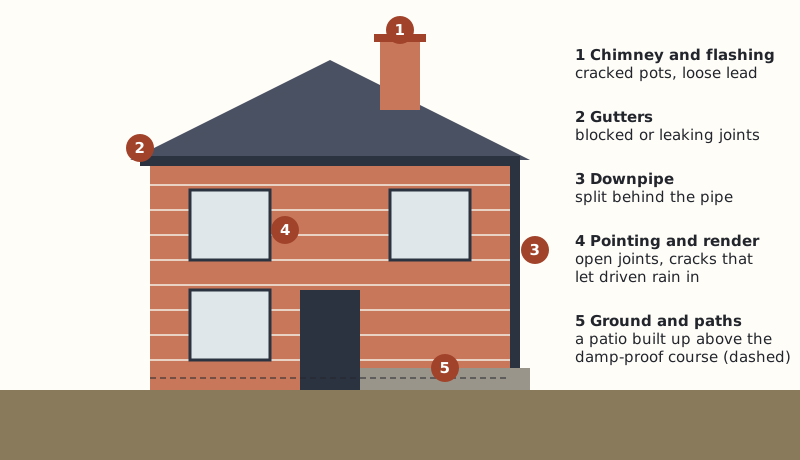
On a survey we trace each stain to the nearest of these points outside, then test the wall behind it. A raised patio belongs on the list too, because it can carry water past the damp course; our rising damp treatment page explains how.
How does rain get through a cavity wall?
In driving rain some water passes the outer brick leaf of any cavity wall; a sound wall copes by draining it away. BRE Good Building Guide 33 explains that, where damp-proofing is correctly designed and the wall is reasonably free of defects, that water runs down the cavity face and out at the footings, cavity trays or lintels. It also says damp in cavity walls is still common, mainly through faulty design or construction or the wrong choice of materials, and covers outer-leaf defects, wall-tie problems and cavity insulation defects.
Mortar droppings left in a cavity can bridge the damp course, as the BRE Digest 245 summary notes. Insulation is another route: the government's cavity wall insulation guide says incorrectly installed insulation can cause internal damp, mould or structural damage. Our guide can cavity wall insulation cause damp? covers that in detail.
Why does wind-driven rain matter so much?
Because rain driven by wind is pushed into a wall rather than running off it. Historic England calls wind-driven rain one of the largest sources of moisture building up within a building's fabric. Approved Document C includes a map of UK driving-rain exposure zones and a table limiting how exposed an insulated masonry wall can be. In practice the wall facing the worst of the weather is the one we look at first.
Why are cement repairs a problem on old brick?
Hard cement mortar and render slow an old wall's drying, so water that gets in stays in. Homebuilding & Renovating, quoting Cornish Lime, says solid-walled buildings from before 1920 were often built with lime mortar and that cement mortars are hard, impervious and can trap moisture. SPAB says hard cement render can impede breathability, that replacing it or repointing in lime may be the best solution, and that waterproof renders and coatings can make damp worse. Historic England calls renders of non or low capillary active materials inappropriate on traditional walls, because water gets trapped behind them.
The 2011 Stafford conservation area appraisal describes the town's historic buildings as built mainly of local materials, particularly red brick, so the mortar question comes up on many older walls here. For scale, the same magazine cites Checkatrade labour figures of £55 per square metre for repointing brickwork and £750 for a chimney, and gives £500 to £2,500 for scaffolding (May 2024): national figures, not our quote.
Did the October 2019 flooding in Stafford affect brickwork?
Flood water is a separate category of damp, but the response to it in Stafford shows how much brickwork joints matter. On 25 and 26 October 2019 persistent rain flooded homes internally, including 37 properties at Sandon Road, Peel Terrace and Freeman Street, according to the county council's Section 19 report. The UKHSA guidance treats flooding as traumatic damp, alongside burst pipes and overflowing baths.
In March 2026 the Environment Agency reported that it had fitted flood doors, flood-resistant air bricks and pumps to 31 properties on Sandon Road, and carried out targeted repointing of brickwork, after years of flooding there (GOV.UK, 5 March 2026). We had no part in that scheme. The lesson for any Stafford owner is that open joints are one of the ways water reaches the inside of a wall, which is why we check pointing on every penetrating damp survey.
In what order should penetrating damp be repaired?
Fix the defect, let the wall dry, then replaster and decorate. That is the staged approach in the Joint Position Statement: deal with obvious defects, allow time for monitoring and drying, then reassess. The PCA Code says impervious coatings should not go on until walls have dried, which may take 1 to 12 months or longer, and does not recommend internal waterproofing as a primary or long-term answer to rain penetration.
Checkatrade gives £1,000 to £3,000 for damp proofing external walls by injection, average £2,000 (prices from November 2024), which shows how much a wrong diagnosis can cost when the real fault is a gutter or open pointing; treat it as a national average, not a quote. For costs across every kind of job, see the damp proofing cost guide, and for everything else we do, our page on damp surveys and damp proofing in Stafford.
Questions we get asked
Should I call a roofer or a damp specialist first?
If you can see the fault, such as a slipped tile or a dripping gutter, start with the roofer. If you cannot find where the water gets in, a damp survey traces it so you pay for the right repair.
Can I seal the inside of the wall instead?
Sealing the inside leaves the wall wet and the defect in place. The outside comes first; inside finishes come last.
How do I tell penetrating damp from rising damp?
Testing tells you. A patch that grows after rain points to a defect outside, and drilled samples show whether the wall is wet from the ground; our rising damp or condensation guide covers the signs.
Where these facts come from
- GOV.UK: Understanding and addressing the health risks of damp and mould in the home (first published 7 Sep 2023, updated 1 Apr 2026)
- RICS: damp and mould, a consumer guide (16 June 2025)
- GOV.UK: English Housing Survey 2024 to 2025, housing quality (29 January 2026)
- Homebuilding & Renovating: how to treat damp in older houses, by SPAB's technical director (updated 8 April 2024)
- RICS Built Environment Journal: Understanding dampness: a pathological approach (5 Nov 2026)
- Designing Buildings Wiki: BRE Good Building Guide 33, building damp-free cavity walls
- Designing Buildings Wiki: summary of BRE Digest 245 on rising damp
- GOV.UK: Cavity wall insulation: consumer guide to issues arising from installations (Oct 2019)
- Historic England: Risks of energy efficiency interventions
- GOV.UK: Approved Document C, resistance to contaminants and moisture
- Homebuilding & Renovating: How much does repointing cost? (4 May 2024)
- SPAB: What is rising damp?
- Stafford Borough Council: Stafford conservation area character appraisal (2011)
- Staffordshire County Council: section 19 flood report on October 2019
- GOV.UK: flood resilience improved for homes in Stafford (5 March 2026)
- RICS, Historic England and the PCA: investigation of moisture in traditional buildings, joint position statement (September 2022)
- Property Care Association: Code of Practice for the investigation and control of dampness in buildings (March 2017)
- Checkatrade: damp proofing cost breakdown (updated 6 April 2025, prices November 2024)
Useful to have ready
Answers to these let us tell you on the phone what kind of damp it probably is.
- The postcode and roughly when the house was built
- Where the damp shows and how high up the wall
- Whether it gets worse after rain, or in cold weather
- Any mould, and in which rooms
- Whether you own, rent or are buying, and any survey deadline
Penetrating damp repairs beyond Stafford
Need penetrating damp somewhere other than the county town? The page below covers that town's own housing and the damp it tends to bring, and our damp proofing in Stafford page has the full picture.
Read these first
Can cavity wall insulation cause damp?
When cavity wall insulation lets damp through, which walls should never have been filled, and how to complain if yours was.
Is it rising damp or condensation?
Where each kind of damp shows, when it gets worse, why meters mislead, and the drilled-sample test that separates rising damp from condensation.
What do damp surveys and damp proofing cost?
National price yardsticks for damp surveys, injection, ventilation, woodworm, dry rot and tanking, each credited and dated, with what pushes a job up or down.
Related damp work
Damp surveys
A survey that works out where the water is coming from, outside and in, before anyone mentions treatment.
Rising damp treatment
Ground moisture proved with samples first, then bridged damp courses cleared or a certified injection fitted where the evidence calls for it.
Condensation and mould
Black spots and streaming windows traced to humidity, cold surfaces and stale air, then cured with ventilation and heating rather than chemicals.
Other work we take on
Woodworm and rot treatment
Woodworm, wet rot and dry rot identified properly, live or long dead, with the damp behind them fixed before any timber is treated.
Cellar and basement tanking
Cellar and basement waterproofing designed to BS 8102, matched to whether the space will hold storage or become a room.
Rather we phoned you?
Leave a name, a number and the postcode of the property. A line about what the damp is doing helps. Or phone 01785 335365.