- Home
- Damp services
- Condensation and mould
Condensation and mould in Stafford
Condensation and mould help in Stafford for owners, tenants and landlords dealing with black spots, wet windows or musty rooms. Stafford Damp Proofing measures humidity and surface temperatures, finds why the air condenses where it does, and recommends the ventilation or heating changes that stop the mould returning.
Get help with mould
Tell us where the property is and what you can see. We call back to talk it through.
- Humidity logged over time
- Extract fans sized to Part F
- No damp course for condensation
Is condensation the most common kind of damp?
Yes. The UKHSA and DHSC guidance calls condensation the most common form of damp: moisture from everyday living settling on cold surfaces such as window frames, wall corners and walls behind furniture. How common it looks depends on who did the measuring. In the English Housing Survey 2024, surveyors assessed serious condensation or mould in 3% of dwellings, while 30% of households reported damp, condensation or mould themselves at interview.
The same government guidance says the root causes are usually building defects or inadequate ventilation, heating or energy efficiency, so a damp-proof course has no part in the cure. If you are not sure which problem you have, our rising damp or condensation guide walks through the signs.
Why does mould grow in cold corners and behind wardrobes?
Because those are the coldest surfaces in the room and the ones with least air moving across them. The PCA Code explains that condensation forms where surfaces fall below the dew point, often where air circulation is poor. NHBC lists colder parts of walls, the edges of doors and windows, the junctions of ceilings and floors with outer walls, cupboards and the space behind furniture against outside walls. Scottish building standards guidance names thermal bridges at lintels, jambs, sills and wall junctions as places where heat escapes and inner surfaces cool.
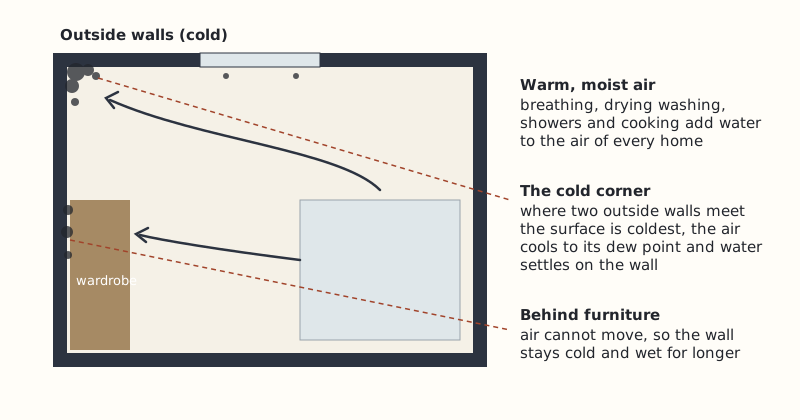
Winter is when this shows up around Stafford. The Met Office station at Penkridge, the nearest to the town, averages 9.25 air frost days in December, 9.63 in January and 9.21 in February (1991 to 2020), with average minimum temperatures of about 2°C. Timberwise explains the effect: cold outside air chills walls and windows, so warm, moist indoor air reaches its dew point on them.
What humidity level lets mould grow?
There is no single number, because the guidance measures humidity in different places. The PCA Code says mould can grow at a relative humidity of around 80% at external walls, well short of the point where droplets form. Scottish guidance, which is technical advice rather than English law, says risk rises when a room's average stays at or above 70% for long periods, because the air at the outside wall will be more humid than the room as a whole. One figure describes a wall surface and the other a room, so they do not contradict each other.
That is why we log rather than spot-check. The Code says one-off readings only show that conditions allowed condensation at that moment, and long-term logging may be needed.
How much extract ventilation do kitchens and bathrooms need?
For work carried out since 15 June 2022, BEAMA's guide to Approved Document F gives minimum intermittent extract rates of 30 litres a second for a kitchen extracting through a cooker hood, 60 litres a second for a kitchen fan elsewhere, and 15 litres a second for a bathroom. It notes that fans may not reach their rated extract once installed, because ducts and grilles resist the flow.
The UKHSA guidance says to make sure kitchen and bathroom fans work and are powerful enough, and to consider humidity-controlled fans or fans with an overrun. NHBC suggests running the fan or opening a window during cooking, bathing and washing and for about 20 minutes after. Checkatrade puts a new extractor fan at around £300 installed (£250 to £350, June 2026), a national figure rather than our price.
Are PIV or dMEV worth fitting?
They can be where better extract alone has not been enough, but neither suits every house. Positive input ventilation uses a fan, usually in the loft, to supply filtered air through a ceiling diffuser and create slight positive pressure that pushes stale air out, as Homebuilding & Renovating describes. The same article points out that PIV is not an extract system, so kitchen and bathroom extract rules still apply, and that it may not suit homes without a loft or where loft air is cold in winter.
dMEV spreads small extract units through the house, typically one per room or zone, running continuously at variable speeds, many of them with sensors (Homebuilding & Renovating on dMEV). On cost, Checkatrade gives £763 to £1,750 for PIV, average £900 (May 2024), and Homebuilding & Renovating puts installed systems at £700 to £1,000. Insulation work changes the picture too: the UKHSA guidance says energy-efficiency improvements can reduce ventilation, so ventilation should be reviewed alongside them.
Is mould a health risk, and is it the occupants' fault?
It is a health risk, and government guidance says blaming the people who live there is wrong. The UKHSA and DHSC guidance lists respiratory effects including coughing, wheezing, breathlessness and new or worse asthma and allergies, and names people at higher risk: children, older people, pregnant women, people with lung or heart conditions or weakened immune systems, and people with a mental health condition. It calls it "totally unreasonable" to blame damp and mould on lifestyle choices, since cooking, bathing and drying laundry cannot be avoided.
If you rent, the rules depend on your landlord. Awaab's Law has applied to social housing since 27 October 2025 (GOV.UK); for private renters it is not yet in force, and the government's consultation on extending it closes on 18 December 2026 (GOV.UK press release). Our guide to Awaab's Law explains what that means. Locally, Stafford Borough Council's housing standards team can advise or serve a legal notice requiring repairs where a landlord does not act.
Why does mould come back after it has been cleaned?
Because cleaning removes the mould, not the moisture that fed it. The UKHSA guidance says simply removing surface mould will not stop it reappearing, and the RICS consumer guide says mould treatment alone will not fix the moisture source. RICS lists drying clothes over radiators, poor ventilation and too little heating as key contributors, and suggests keeping indoor temperatures around 18 to 21°C.
Painting over it is no cure either: Historic England warns that impermeable paints over traditional finishes can increase surface condensation and mould risk. A lasting fix for condensation and mould in a Stafford home means changing the conditions in the room, and the black mould guide covers what you can do yourself. For other damp problems, see damp proofing in Stafford.
Questions we get asked
Will a dehumidifier solve condensation?
It lowers the humidity while it runs, which helps while the cause is dealt with. The lasting answer is ventilation, heating or insulation.
Do I need a survey for condensation?
Not always. If mould sits in cold corners and fades when rooms are aired and heated, start with fans and heating; book a damp survey if it persists, or if damp also appears low on walls or after rain.
I rent my home. Who should fix the mould?
Report it to your landlord in writing and keep a copy. Our Awaab's Law guide sets out which rules apply to social and private tenants.
Where these facts come from
- GOV.UK: Understanding and addressing the health risks of damp and mould in the home (first published 7 Sep 2023, updated 1 Apr 2026)
- GOV.UK: English Housing Survey 2024 to 2025, housing quality (29 January 2026)
- Property Care Association: Code of Practice for the investigation and control of dampness in buildings (March 2017)
- NHBC: Condensation in your home (homeowner leaflet)
- Scottish Government: building standards technical handbook 2022, condensation
- Met Office: Penkridge climate averages, 1991 to 2020
- Timberwise: Why does condensation get worse in winter? (23 Nov 2021, updated 28 Jul 2025)
- BEAMA: guidance on Part F of the Building Regulations for dwellings in England (2022)
- Checkatrade: Extractor fan installation cost (last updated June 2026)
- Homebuilding & Renovating: Positive Input Ventilation explained (9 Sep 2021, updated 12 Jul 2024)
- Homebuilding & Renovating: What is dMEV? (9 Jan 2024)
- Checkatrade: PIV installation cost (prices updated May 2024)
- GOV.UK: Awaab's Law: guidance for social landlords: timeframes for repairs in the social rented sector (17 Oct 2025, updated 16 Jul 2026)
- GOV.UK: clampdown on dangerous homes to protect more tenants and families (8 October 2026)
- Stafford Borough Council: damp, condensation and mould
- RICS: damp and mould, a consumer guide (16 June 2025)
- Historic England: Risks of energy efficiency interventions
Useful to have ready
Answers to these let us tell you on the phone what kind of damp it probably is.
- The postcode and roughly when the house was built
- Where the damp shows and how high up the wall
- Whether it gets worse after rain, or in cold weather
- Any mould, and in which rooms
- Whether you own, rent or are buying, and any survey deadline
Condensation and mould beyond Stafford
Need condensation and mould somewhere other than the county town? The page below covers that town's own housing and the damp it tends to bring, and our damp proofing in Stafford page has the full picture.
Read these first
Why is black mould growing on my walls, and how do I stop it?
Why black mould appears on cold walls and in bedrooms, who it harms most, and which fixes last longer than a bottle of mould wash.
What is Awaab's Law, and what does it mean for damp and mould in rented homes?
Who Awaab's Law covers, the deadlines social landlords must meet on damp and mould, and where private renting stands in late 2026.
Is it rising damp or condensation?
Where each kind of damp shows, when it gets worse, why meters mislead, and the drilled-sample test that separates rising damp from condensation.
Related damp work
Damp surveys
A survey that works out where the water is coming from, outside and in, before anyone mentions treatment.
Rising damp treatment
Ground moisture proved with samples first, then bridged damp courses cleared or a certified injection fitted where the evidence calls for it.
Penetrating damp repairs
Rain finding its way through walls, chimneys or tired pointing, traced back to the fault outside and repaired before plaster goes back.
Other work we take on
Woodworm and rot treatment
Woodworm, wet rot and dry rot identified properly, live or long dead, with the damp behind them fixed before any timber is treated.
Cellar and basement tanking
Cellar and basement waterproofing designed to BS 8102, matched to whether the space will hold storage or become a room.
Rather we phoned you?
Leave a name, a number and the postcode of the property. A line about what the damp is doing helps. Or phone 01785 335365.