- Home
- Damp guides
- Cavity insulation
Sources opened and read on 12 November 2026
Can cavity wall insulation cause damp?
Cavity wall insulation can cause damp when it goes into the wrong walls or is installed badly. This guide is for Stafford homeowners and landlords with damp patches on insulated walls: it explains how that happens, how a survey tells it apart from other causes, and the route for a complaint.
Arrange a damp survey
Tell us where the property is and what you can see. We call back to talk it through.
Can cavity wall insulation really cause damp?
Yes, when it is put into unsuitable walls or installed badly. The government's 2019 consumer guide says incorrectly installed cavity wall insulation can cause internal damp, mould or structural damage.
The reason lies in how a cavity wall handles rain. BRE's Good Building Guide 33 explains that in driving rain, water passes through the outer leaf. Where the damp-proofing is well designed and the wall is in reasonable condition, that water runs down the inside face of the outer leaf and out through the footings, cavity trays or lintels. The same guide says damp in cavity walls is still common, mainly through faulty design or construction or the wrong materials, and it lists cavity insulation defects among the problems.
Most insulated walls stay dry. The trouble comes where the wall was never suitable, the work was poor, or something else, such as a gutter or pointing, has since failed.
Which walls are unsuitable for cavity insulation?
Walls exposed to driving rain, walls in poor condition, walls that are already damp, and early cavity walls. The Energy Saving Trust says walls to be filled should not be exposed to driving rain, the masonry should be in good condition, and any damp patches on internal walls should be fixed before insulating.
Historic England adds that filling an early cavity wall risks liquid moisture reaching the interior, so such walls should be treated like solid walls. Older solid walls are a different case again and are not cavity walls at all.
If your walls were filled despite one of these warning signs, that is worth noting for any complaint. Ask the installer or guarantee provider what assessment was made before the work went ahead.
How much does wind-driven rain matter?
A great deal: it is the main reason suitable and unsuitable walls differ. Historic England calls wind-driven rain one of the largest sources of moisture building up within a building's fabric.
Exposure varies across the country, and the rules reflect that. Approved Document C includes a map of UK driving-rain exposure zones and a table of the maximum exposure zones for insulated masonry walls. BRE's Good Building Guide 44 (2001) gives a national map of wind-driven rain exposure zones for insulating cavity walls. A wall facing the prevailing weather is more exposed than a sheltered one on the same house.
What happens when exposure is misjudged shows up in a BRE study of a small sample of Welsh homes, summarised by LABC. It found some insulation had been installed in unsuitable properties, that failures all fell within the 25-year guarantee period and some within 10 years, and it pointed to weaknesses in assessing wind-driven rain risk.
How does a survey tell insulation damp from other causes?
By ruling out the other causes first, then checking the cavity itself. A damp patch on an insulated wall is not proof the insulation is to blame. SPAB's technical director lists defective roofs, poor rainwater goods and plumbing leaks as causes that affect all buildings; a summary of BRE Digest 245 notes that mortar droppings in a cavity can bridge the damp course; and condensation forms on cold spots in any wall.
The PCA Code of Practice says moisture meters cannot tell one source from another, so all possible causes must be considered. A careful survey therefore looks outside at gutters, downpipes, pointing, render and ground levels, maps where the damp sits and when it appears, and then looks into the cavity. MyBuilder's price guide lists thermal imaging and borescope inspection as part of a comprehensive damp survey.
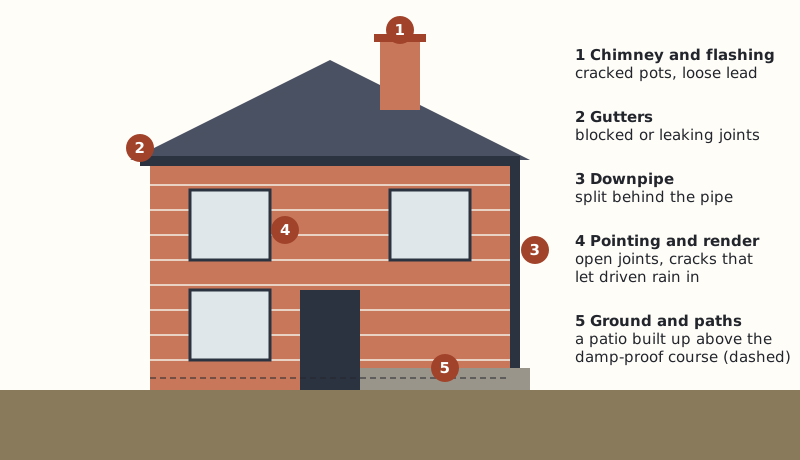
Damp that follows rain on an exposed elevation, with clean gutters and sound pointing, points towards the cavity. Damp under a leaking gutter points to the gutter. Our damp surveys and penetrating damp work follow that order, and the guide to rising damp or condensation covers the other common confusions.
Who do you complain to if the insulation is faulty?
The installer first, then the guarantee provider, then Ofgem for installations under ECO. That is the route in the government consumer guide: contact the installer; if they have stopped trading or have not resolved it, go to the guarantee provider, which is CIGA for CIGA guarantees; and for insulation fitted under the ECO scheme, complaints about installation standards can go to Ofgem.
The Energy Saving Trust says an installation should carry a 25-year guarantee, from CIGA or an independent insurance-backed provider, so find that paperwork before you start. An independent survey report on the cause gives the complaint something firm to rest on.
Should you trust a call offering compensation?
Be cautious. The government guide warns that claims management companies cold-call by phone and door to door offering compensation for faulty cavity wall insulation, and that some cases are not genuine. It advises not signing anything on the doorstep and checking any charges in writing first.
A genuine problem can go through the installer and guarantee route above without a middleman. If you are unsure whether your damp has anything to do with the insulation, get the cause checked before signing up to a claim.
What should happen before walls are insulated or re-insulated?
Damp should be fixed first, and ventilation thought about at the same time. The Energy Saving Trust says damp patches should be dealt with before insulating, and UKHSA and DHSC guidance says energy-efficiency work can reduce ventilation, so ventilation should be reviewed alongside it. Under the simplified method in BEAMA's summary of Part F, up to two minor measures such as loft or cavity insulation need no extra ventilation, while more than that does.
The RICS building pathology article also warns against combining a retrofit chemical damp course with wall insulation, which can trap moisture. For damp proofing in Stafford and the villages around it, Stafford Damp Proofing looks at the whole wall, including the insulation, before recommending any repair.
Questions we get asked
How long should cavity wall insulation be guaranteed for?
The Energy Saving Trust says installations should carry a 25-year guarantee from CIGA or an independent insurance-backed provider. Check your paperwork to see which you have.
Can damp appear years after the insulation went in?
Yes. A BRE study of Welsh homes, summarised by LABC, found failures inside the 25-year guarantee period, some within 10 years.
Is all damp on an insulated wall caused by the insulation?
No. Leaking gutters, bridged damp courses and condensation all cause damp on cavity walls, so the cause needs confirming before a claim or a repair.
Where these facts come from
- GOV.UK: Cavity wall insulation: consumer guide to issues arising from installations (Oct 2019)
- Designing Buildings Wiki: BRE Good Building Guide 33, building damp-free cavity walls
- Energy Saving Trust: Cavity wall insulation
- Historic England: Energy efficiency and historic buildings, insulating solid walls
- Historic England: Risks of energy efficiency interventions
- GOV.UK: Approved Document C, resistance to contaminants and moisture
- BRE: Insulating masonry cavity walls, Part 2 (Good Building Guide 44, 2001)
- LABC: BRE report raises concerns over post-installation performance of cavity wall and external wall insulation
- Homebuilding & Renovating: how to treat damp in older houses, by SPAB's technical director (updated 8 April 2024)
- Designing Buildings Wiki: summary of BRE Digest 245 on rising damp
- Property Care Association: Code of Practice for the investigation and control of dampness in buildings (March 2017)
- MyBuilder: damp survey cost (undated)
- GOV.UK: Understanding and addressing the health risks of damp and mould in the home (first published 7 Sep 2023, updated 1 Apr 2026)
- BEAMA: guidance on Part F of the Building Regulations for dwellings in England (2022)
- RICS Built Environment Journal: Understanding dampness: a pathological approach (5 Nov 2026)
Useful to have ready
Answers to these let us tell you on the phone what kind of damp it probably is.
- The postcode and roughly when the house was built
- Where the damp shows and how high up the wall
- Whether it gets worse after rain, or in cold weather
- Any mould, and in which rooms
- Whether you own, rent or are buying, and any survey deadline
Ready to have someone look? Our damp proofing in Stafford page sets out what we survey, what we treat and where we go.
Where this guide leads
Damp surveys
A survey that works out where the water is coming from, outside and in, before anyone mentions treatment.
Penetrating damp repairs
Rain finding its way through walls, chimneys or tired pointing, traced back to the fault outside and repaired before plaster goes back.
More reading
What do damp surveys and damp proofing cost?
National price yardsticks for damp surveys, injection, ventilation, woodworm, dry rot and tanking, each credited and dated, with what pushes a job up or down.
Is it rising damp or condensation?
Where each kind of damp shows, when it gets worse, why meters mislead, and the drilled-sample test that separates rising damp from condensation.
Why is black mould growing on my walls, and how do I stop it?
Why black mould appears on cold walls and in bedrooms, who it harms most, and which fixes last longer than a bottle of mould wash.
Dry rot or wet rot: what is the difference?
The difference between dry rot and wet rot is how far it spreads, not how much harm it does. Signs, causes and treatment order.
Is rising damp a myth?
Rising damp is real but less common than often claimed. Both sides of the debate, the evidence, and the steps everyone agrees on.
What is Awaab's Law, and what does it mean for damp and mould in rented homes?
Who Awaab's Law covers, the deadlines social landlords must meet on damp and mould, and where private renting stands in late 2026.
Rather we phoned you?
Leave a name, a number and the postcode of the property. A line about what the damp is doing helps. Or phone 01785 335365.