- Home
- Damp services
- Cellar and basement tanking
Cellar and basement tanking in Stafford
Basement tanking in Stafford for owners with a wet cellar or plans to turn one into living space. Stafford Damp Proofing works out where the water comes from, explains which BS 8102 type and grade fits the use you have in mind, and sets out the upkeep any drained system will need.
Talk about your cellar
Tell us where the property is and what you can see. We call back to talk it through.
- The BS 8102 grades explained
- Grade matched to the use
- Upkeep of drained systems covered
What is basement tanking, and which standard covers it?
Basement tanking is the everyday name for waterproofing a cellar or basement, and the standard behind the design is BS 8102:2022, published on 31 March 2022. It covers keeping groundwater, surface water and flood water out of structures partly or wholly below ground, and takes in external drainage, openings, groundwater evaluation, ground gases and risk assessment.
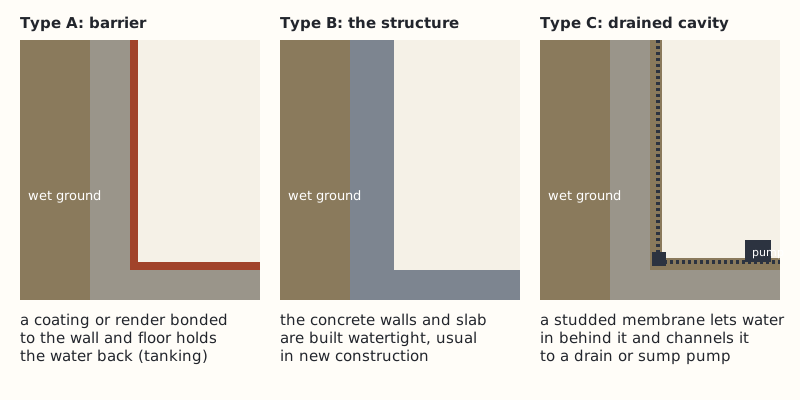
The standard describes three types of protection, explained by Newton Waterproofing in the Building Design Index:
- Type A, barrier protection: a liquid or sheet membrane applied to the structure, inside or outside.
- Type B, integral protection: the structure itself is the waterproofing.
- Type C, drained protection: an internal drainage system collects and removes water that has passed through the structure.
Which waterproofing grade does a cellar need for storage or for living?
The grade depends on what the space is for, and it sets how dry the finished cellar must be. Under the 2022 standard, as PBC Today summarises and Building Engineer explains:
- Grade 1A allows some seepage and damp areas, provided they do not affect the intended use. Building Engineer gives an underground car park as a Grade 1 example.
- Grade 1B allows no seepage but tolerates damp areas.
- Grade 2 accepts no water seepage; dampness from condensation or moist air is tolerated.
- Grade 3 accepts no water ingress or dampness at all and needs heating, ventilation and humidity control.
Which grade a cellar needs depends on what it will be used for, so it is worth settling at the start: it avoids paying for a living-room specification in a store, or the reverse.
What changed in BS 8102 in 2022?
Several changes affect owners directly. The PBC Today summary lists them: Grade 1 split into 1A and 1B, with seepage defined separately from damp; a waterproofing design specialist should be consulted at the design stage; Type C systems should come with a maintenance schedule, starting with a first service inspection at handover; waterproofing should be continuous with the damp-proof course or run 150 mm above external ground level; and the scope now reaches doors, light wells, air bricks, buried roofs and podium decks.
The maintenance point is easy to overlook. A drained system keeps working only while its channels and any pump are looked after, so ask for the schedule in writing before work starts.
Can internal tanking cure damp in walls above ground?
No. The PCA Code of Practice says internal waterproofing is not recommended as a primary or long-term remedy for rising damp or for rain penetration. Walls below ground or under water pressure are a different case: BS 6576, the rising damp standard, excludes them and points to BS 8102. So a damp patch in a ground-floor room belongs with rising damp treatment or penetrating damp repairs, and tanking belongs in the cellar.
Why does the ground under Stafford matter for a cellar?
Because a cellar sits in whatever water the surrounding ground holds. The Stafford conservation area appraisal describes the town on glacial gravel and sand, with alluvial marshland around it, Keuper Marl clay in the surrounding countryside, and the River Sow on its west and south sides. The 2014 strategic flood risk assessment says Mercia Mudstone deposits underlie most of the borough, with sand and gravel deposits that hold extensive groundwater resources.
The same assessment says groundwater flooding susceptibility is greatest along the River Trent and where the Sow and Penk converge, which is in Stafford town, though it also notes that a 2010 study reported no known groundwater problems. That does not mean every cellar in the town is wet. It does mean a design should start from what the ground is doing rather than an assumption, which is what BS 8102's groundwater evaluation is for.
Do you need planning permission or building regulations to convert a cellar?
Usually not planning permission, but building regulations do apply. The Planning Portal says converting an existing basement is unlikely to need planning permission, while digging a new one probably will, and that regulations covering fire escape routes, ventilation and damp proofing apply to basement builds and conversions. It adds that listed buildings will likely need consent, and Stafford borough has 836 of them. If your plan is a habitable room, tell us at the start, because the grade, ventilation and escape route all follow from it.
Who should design cellar waterproofing, and what does it cost?
Ask for a Certificated Surveyor in Structural Waterproofing, the PCA's CSSW qualification for people who diagnose water entering structures below ground and recommend design solutions. Building Engineer says warranty companies generally require a CSSW designer. Ask too which BS 8102 type and grade the design targets and what the maintenance schedule will be.
National cost guides vary widely. Checkatrade gives £100 to £200 per square metre for basement tanking, average £125 (November 2024 prices). MyBuilder gives £60 to £120 per square metre for cementitious tanking, £80 to £150 for a cavity drain system and £500 to £1,500 for a sump pump, on an undated page using 2026 figures, and Homebuilding & Renovating puts professional tanking slurry at £30 to £60 per square metre. None of these is our price. For other work, see damp proofing in Stafford or the cost guide.
Questions we get asked
Does a cellar used only for storage need full waterproofing?
Not always to the highest grade. The grade should match what you keep there and how dry it must stay, and we explain the options before any design is drawn up.
Will a drained Type C system need servicing?
Yes. It relies on its channels and pump, and the 2022 standard expects a maintenance schedule with a first inspection at handover.
Can you tank a wall that is damp above ground level?
Tanking is meant for walls below ground. Damp higher up has another cause, usually covered on our penetrating damp or rising damp pages.
Where these facts come from
- BSI: BS 8102:2022, protecting below-ground structures against water
- Building Design Index (Newton Waterproofing): what is Type A structural waterproofing?
- PBC Today: A summary of changes to the British Standard 8102:2022 (21 Dec 2022)
- Building Engineer: water, water everywhere, but none in the basement
- Property Care Association: Code of Practice for the investigation and control of dampness in buildings (March 2017)
- BSI: BS 6576, diagnosing rising damp and installing chemical damp-proof courses
- Stafford Borough Council: Stafford conservation area character appraisal (2011)
- Stafford Borough Council: strategic flood risk assessment for southern Staffordshire (2014)
- Planning Portal: basement conversions, planning permission and building regulations
- Stafford Borough Council: listed buildings in the borough
- Property Care Association: the CSSW structural waterproofing qualification
- Checkatrade: damp proofing cost breakdown (updated 6 April 2025, prices November 2024)
- MyBuilder: cellar conversion cost (undated, 2026 figures)
- Homebuilding & Renovating: How much does damp proofing cost? (9 Apr 2024)
Useful to have ready
Answers to these let us tell you on the phone what kind of damp it probably is.
- The postcode and roughly when the house was built
- Where the damp shows and how high up the wall
- Whether it gets worse after rain, or in cold weather
- Any mould, and in which rooms
- Whether you own, rent or are buying, and any survey deadline
Cellar and basement tanking beyond Stafford
Need basement tanking somewhere other than the county town? The page below covers that town's own housing and the damp it tends to bring, and our damp proofing in Stafford page has the full picture.
Read these first
What do damp surveys and damp proofing cost?
National price yardsticks for damp surveys, injection, ventilation, woodworm, dry rot and tanking, each credited and dated, with what pushes a job up or down.
Is it rising damp or condensation?
Where each kind of damp shows, when it gets worse, why meters mislead, and the drilled-sample test that separates rising damp from condensation.
Related damp work
Other work we take on
Damp surveys
A survey that works out where the water is coming from, outside and in, before anyone mentions treatment.
Rising damp treatment
Ground moisture proved with samples first, then bridged damp courses cleared or a certified injection fitted where the evidence calls for it.
Penetrating damp repairs
Rain finding its way through walls, chimneys or tired pointing, traced back to the fault outside and repaired before plaster goes back.
Condensation and mould
Black spots and streaming windows traced to humidity, cold surfaces and stale air, then cured with ventilation and heating rather than chemicals.
Rather we phoned you?
Leave a name, a number and the postcode of the property. A line about what the damp is doing helps. Or phone 01785 335365.