- Home
- Damp services
- Rising damp treatment
Rising damp treatment in Stafford
Rising damp treatment in Stafford starts by proving the problem is rising damp. Stafford Damp Proofing helps owners with a tide mark low on their walls find out whether ground moisture really is the cause, then puts right a bridged or missing damp course in a way that suits the wall.
Ask about a tide mark
Tell us where the property is and what you can see. We call back to talk it through.
- Bridged damp courses checked first
- Injection only where samples confirm
- Lime repairs for older walls
What does genuine rising damp look like?
Genuine rising damp shows as a tide mark low on a ground-floor wall with a band of salts above it. The PCA Code of Practice describes water drawn up from the ground by capillary action, typically showing as a tide mark up to about a metre with hygroscopic salts concentrated above it. It can climb higher: the summary of BRE Digest 245 says porous walls standing in water or saturated soil without a damp-proof course can show rising damp above a metre, with the height set by evaporation, porosity, salts, groundwater and heating.
SPAB adds that genuine cases are likely to show high nitrate levels, and warns that rainsplash off a path can mimic the pattern. So the fair summary is typically up to about a metre, sometimes higher, and always confirmed by testing.
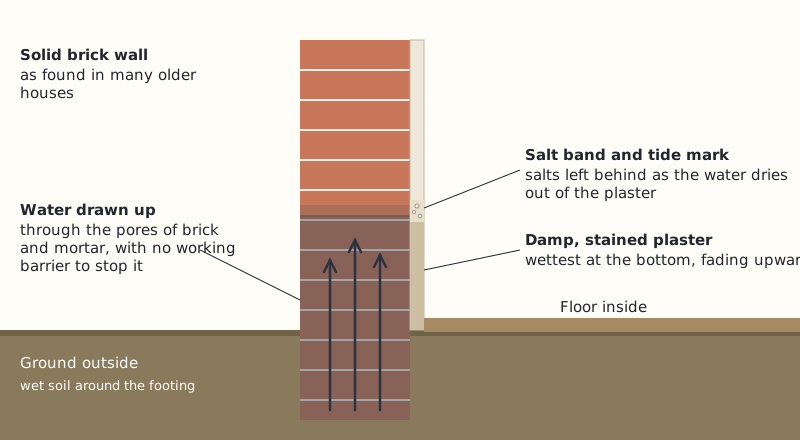
How common is rising damp in English homes?
It is the least common of the three main kinds of damp. In the English Housing Survey 2024, surveyors found rising damp in 1% of dwellings, penetrating damp in 2% and serious condensation or mould in 3%. By tenure, rising damp was found in 1% of owner-occupied homes and 3% of private rented ones.
Which? puts it plainly: rising damp can be the most expensive type to fix but is one of the least common. That gap between cost and frequency is why we test before quoting. If your tide mark turns out to be something else, our guide to telling rising damp from condensation explains the difference.
Why is rising damp so often misdiagnosed?
Because a wet wall near the floor looks much the same whatever made it wet, and a meter cannot tell the sources apart. The RICS consumer guide calls rising damp often misdiagnosed, says failure of an original damp-proof course is extremely rare, and says wrongly blaming it leads to unnecessary replacement. A November 2026 RICS article reports that many properties receive unnecessary chemical damp courses while the real moisture sources remain, so the damp and mould return.
SPAB's position is that rising damp is real but rarer than assumed. The Joint Position Statement asks surveyors to deal with causes, not symptoms. A damp survey with drilled samples is how we separate the cases, and the wider debate is set out in is rising damp a myth?
What is a bridged damp-proof course?
It is a damp course that still works but has been bypassed, usually because soil, a path or a patio now sits above it. Approved Document C says an external wall's damp-proof course should be at least 150 mm above adjoining ground. Once the ground outside rises past that line, the damp course no longer separates the wall from wet ground.
The RICS pathology article gives a case of exactly this: rising damp commercially diagnosed as a failed damp course, when the real cause was a high external patio bridging it. BRE Digest 245 says an existing physical damp course is rarely faulty because the materials last a long time, though debris such as mortar in a cavity can bridge it, and SPAB's technical director lists raised ground levels among the causes of moisture problems. In these cases the repair is outside: take the ground or patio back below the damp course or clear the cavity, then give the wall time to dry.
Which rising damp treatments are proven to work?
Where testing confirms rising damp and a physical damp course is not feasible, chemical injection is the only retrofit method with third-party certification. SPAB follows BRE advice to use only methods with an Agrément or other third-party certificate and says injection is currently the only one that meets it. The PCA Code agrees, adding that electro-osmosis lacks British third-party accreditation. The British Standard for diagnosis and chemical damp courses is BS 6576.
Injection is only half the job. The same Code says salt-contaminated plaster should come off to at least 300 mm above the last detectable dampness and be replaced with salt-resistant plaster, and that impervious coatings should wait until the wall has dried, which may take 1 to 12 months or longer. It does not recommend internal waterproofing as a primary or long-term remedy for rising damp. The RICS article also warns against combining a retrofit chemical damp course with wall insulation, which can trap moisture.
On cost, Checkatrade gives £1,000 to £3,000 for a medium-sized property, average £2,000, or £60 to £200 per metre (prices from November 2024), while Homebuilding & Renovating estimated £195 per metre including replastering in April 2024. Both are national guide figures, not a price from us.
Should an old solid wall built with lime be injected?
Usually not. SPAB says there should be a presumption against retrofit damp courses in buildings from before about 1919, because they can be damaging, ineffective and costly, with exceptions where alterations have made a building behave like a sealed modern structure. Traditional walls of brick, stone and lime absorb moisture and let it evaporate in drier conditions, as the Joint Position Statement describes, so the aim is to help them dry rather than seal them.
That often means removing hard cement render or repointing in lime, both of which SPAB suggests, and avoiding the impermeable paints that Historic England links to more condensation and mould. Stafford's historic buildings were built mainly of local materials, particularly red brick, and many early timber-framed buildings in the town were faced with brick in the 19th century, according to the town centre conservation area appraisal.
Do you need listed building consent for damp proofing in Stafford?
Very likely, if the building is listed. The Planning Portal says that, typically, installing damp proofing will require listed building consent, and section 7 of the Listed Buildings Act 1990 bars works affecting a listed building's character without it. SPAB notes that even salt-resistant plasters can need consent. Stafford borough has 836 listed buildings, 23 of them Grade I and 69 Grade II*. If yours is one, we raise consent before any work is priced, so the route to damp proofing in Stafford for a listed home starts with the council.
Questions we get asked
Can you just inject the walls and be done with it?
Not until samples show the wall is wet from the ground and nothing simpler, such as a bridged damp course, explains it. Injecting without that evidence is how damp comes back.
How long before I can redecorate after treatment?
Not until the wall has dried out, which can take many months, because painting a wet wall traps the moisture in. We tell you what to look for before you decorate.
Will a new damp-proof course stop mould on my bedroom walls?
No. Mould in corners and high on walls points to condensation, which a damp course does nothing for; our condensation and mould page covers that.
My house was built before 1919. What should I ask for?
Ask for an investigation that looks at ground levels, pointing, render and paint before any damp course is discussed, and a report that explains whether lime-based repairs would work.
Where these facts come from
- Property Care Association: Code of Practice for the investigation and control of dampness in buildings (March 2017)
- Designing Buildings Wiki: summary of BRE Digest 245 on rising damp
- SPAB: What is rising damp?
- GOV.UK: English Housing Survey 2024 to 2025, housing quality (29 January 2026)
- Which?: damp-proofing companies (page dated 5 May 2026)
- RICS: damp and mould, a consumer guide (16 June 2025)
- RICS Built Environment Journal: Understanding dampness: a pathological approach (5 Nov 2026)
- RICS, Historic England and the PCA: investigation of moisture in traditional buildings, joint position statement (September 2022)
- GOV.UK: Approved Document C, resistance to contaminants and moisture
- BRE: Rising damp in walls, diagnosis and treatment (Digest 245, 2007)
- Homebuilding & Renovating: how to treat damp in older houses, by SPAB's technical director (updated 8 April 2024)
- BSI: BS 6576, diagnosing rising damp and installing chemical damp-proof courses
- Checkatrade: damp proofing cost breakdown (updated 6 April 2025, prices November 2024)
- Homebuilding & Renovating: How much does damp proofing cost? (9 Apr 2024)
- Historic England: Risks of energy efficiency interventions
- Stafford Borough Council: Stafford conservation area character appraisal (2011)
- Planning Portal: damp proofing
- legislation.gov.uk: section 7 of the Planning (Listed Buildings and Conservation Areas) Act 1990
- Stafford Borough Council: listed buildings in the borough
Useful to have ready
Answers to these let us tell you on the phone what kind of damp it probably is.
- The postcode and roughly when the house was built
- Where the damp shows and how high up the wall
- Whether it gets worse after rain, or in cold weather
- Any mould, and in which rooms
- Whether you own, rent or are buying, and any survey deadline
Rising damp treatment beyond Stafford
Need rising damp treatment somewhere other than the county town? The page below covers that town's own housing and the damp it tends to bring, and our damp proofing in Stafford page has the full picture.
Read these first
Is rising damp a myth?
Rising damp is real but less common than often claimed. Both sides of the debate, the evidence, and the steps everyone agrees on.
Is it rising damp or condensation?
Where each kind of damp shows, when it gets worse, why meters mislead, and the drilled-sample test that separates rising damp from condensation.
What do damp surveys and damp proofing cost?
National price yardsticks for damp surveys, injection, ventilation, woodworm, dry rot and tanking, each credited and dated, with what pushes a job up or down.
Related damp work
Damp surveys
A survey that works out where the water is coming from, outside and in, before anyone mentions treatment.
Penetrating damp repairs
Rain finding its way through walls, chimneys or tired pointing, traced back to the fault outside and repaired before plaster goes back.
Condensation and mould
Black spots and streaming windows traced to humidity, cold surfaces and stale air, then cured with ventilation and heating rather than chemicals.
Other work we take on
Woodworm and rot treatment
Woodworm, wet rot and dry rot identified properly, live or long dead, with the damp behind them fixed before any timber is treated.
Cellar and basement tanking
Cellar and basement waterproofing designed to BS 8102, matched to whether the space will hold storage or become a room.
Rather we phoned you?
Leave a name, a number and the postcode of the property. A line about what the damp is doing helps. Or phone 01785 335365.